The Myth of the Dating App Shadowban: Why It Is Almost Always First-Frame Blindness
The algorithm did not bury your card in secret. Strangers are bouncing on an uncalibrated lead photo.
Review your lead photo, gallery sequence, bio claims, and prompt coherence in private before spending on boosts or rewrites.
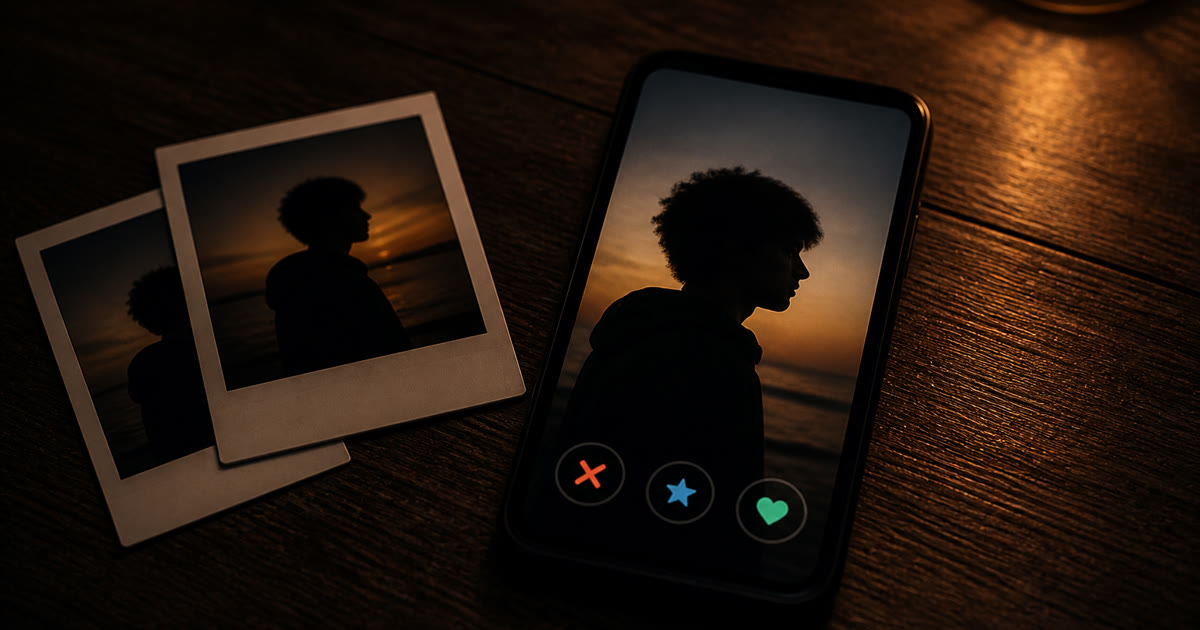
The Myth of the Shadowban
Something changes, and you notice it fast. Matches that used to arrive every few days stop arriving altogether. Likes on apps where you previously saw a steady trickle dry up to nothing. You open the app with the same expectation you had last month, and the same profile greets you with silence. For many men experiencing this sudden drop, the first explanation that comes to mind is punishing in its simplicity: the app must be hiding me on purpose.
That belief has a name, or at least a label the internet has given it, the shadowban. The idea is that dating platforms quietly suppress certain accounts, showing their profiles to fewer people or nobody at all, without ever notifying the user. It is an appealing theory because it fits the emotional shape of the experience. You did nothing differently, yet everything changed, so someone else must have done something to you. The shadowban narrative gives the confusion a villain, and the villain requires no evidence because it operates in secret by definition.
There is a real problem with this theory, and it is not that platforms are incapable of moderation. It is that the shadowban explanation stops the investigation before it starts. If you believe you have been silently buried, there is nothing to check, nothing to fix, and nothing to learn. You are either a victim of an invisible algorithm or you are not, and no amount of examining your own profile will tell you which. That is a dead end, and dead ends are expensive when your dating life is the thing on hold.
The alternative explanation is far less dramatic and far more actionable: what looks like suppression is very often first-frame blindness. Your profile is being shown, but the first thing people see, the opening frame, the primary photo, the initial impression your profile makes in a split-second swipe decision, is not stopping anyone. A profile can be fully visible, fully functional, and fully shown to real people while still producing nothing, because the first frame fails its one job. Visibility was never the bottleneck. Attention was.
The distinction matters because the two explanations lead to completely different next steps. If you have been shadowbanned, the only rational move is to wait, plead with support, or delete and reinstall in the hope of a reset. If your first frame is blind, the move is to audit the signal your profile actually sends, identify where the opening impression breaks down, and correct it in a deliberate order. One path is passive and unverifiable. The other is concrete, testable, and entirely within your control.
This article walks through that second path. In the sections ahead, we will look at why the sudden drop feels like a ban, what first-frame blindness actually is at the level of mechanism, how a private profile signal audit separates a visibility problem from an attention problem, and what a correction order looks like when you fix the right thing first instead of everything at once. The goal is not to convince you that suppression never happens anywhere. The goal is to show you that the explanation you can verify is almost always the one sitting in your first frame, not one hiding in a moderator's queue.
Start here, then, with a simpler question than "am I banned?" Ask instead: "what is the first thing people see, and is it working?" Everything that follows builds from that question.
Mechanism: how the failure actually works
To understand why "shadowban" feels so real, you have to understand what a dating app actually evaluates when it decides who sees your profile. A matchmaking system does not read your profile the way a person does, top to bottom, with patience and goodwill. It processes signals in a priority order, and the signals at the front of that queue carry disproportionate weight because they have to do the work of earning attention for everything behind them.
The first signal in that queue is what we call the first frame: the primary photo a viewer sees before swiping, tapping, or scrolling anywhere else. The first frame is the only asset on your profile that gets evaluated by every single viewer, every single time. Your bio, your secondary photos, your prompts, your interests, all of those are conditional assets. They are only seen by people who already passed the gate the first frame controls. If the first frame fails to hold attention for even a second, nothing downstream of it ever gets read, and the profile effectively performed as if the rest of it did not exist.
This is why the failure pattern feels like a ban. When your first frame stops converting attention into views, the observable result from your side of the glass is a sudden, unexplained drop in likes and matches. Nothing on your end changed (you did not violate a rule, you did not get a warning) so the mind searches for a cause with intent behind it, and "they must be suppressing me" is the story that fits the evidence. But the same drop is fully explained by a simpler mechanism: the profile's first impression stopped doing its job, and the app's distribution responded to that performance signal.
There is a second layer to the mechanism. Dating apps use engagement behavior as feedback. When viewers consistently swipe away quickly, the system learns that showing your profile produces low-yield sessions, and it adjusts accordingly. That adjustment is not punishment and it is not secret enforcement, it is the same allocation logic that governs every profile on the platform. But because the adjustment happens silently and symmetrically, it is indistinguishable from a ban to the person experiencing it. The feedback loop runs like this: weak first frame, fewer completed views, weaker engagement signals, reduced visibility, fewer opportunities for the profile to prove itself. Each cycle reinforces the last, which is why the decline often feels abrupt even though the underlying signal shifted gradually.
What breaks the loop is not waiting out an imaginary penalty. It is identifying which specific signals at the front of your profile are failing, the first frame above all, but also the elements a viewer hits in the first seconds after it, and correcting them in the right order. Correction order matters because fixing a secondary photo before fixing the primary one produces almost no observable change, since few viewers ever reach the secondary one.
This is exactly what our private profile signal audit is built to do. It is an evidence-based review of the signals your profile is actually sending, delivered with a correction order, the specific sequence of fixes most likely to restore engagement, starting with the first frame. No speculation about platform conspiracies, no guessing. Just the mechanism, examined, and the fixes ranked. If your matches dropped and nothing on your end changed, the most probable explanation is that your profile's front door stopped working, and that is a problem with a known cause and a known repair.
Gap vs the Obvious Public Alternative
If the shadowban is a myth and first-frame blindness is the real problem, the natural question becomes: what should a man actually do about it? The obvious public alternative (the one flooding forums, Reddit threads, and YouTube tutorials) is to fix the problem yourself using free advice. Delete and reinstall the app. Wait forty-eight hours. Rewrite your bio with keywords. Swap in new photos taken in better lighting. Ask a female friend to review your pictures. These suggestions circulate widely because they are cheap, accessible, and superficially plausible, and some of them touch on real variables. The gap between that public advice and what actually resolves the problem is the subject of this section.
The first gap is diagnosis. Public advice starts with remedies, not with evidence. When a man reads "your photos are probably the problem," he is being handed a conclusion without an audit. He then guesses at which photo is weak, which line in his bio is costing him, and which fix to try first. Because dating apps rarely show you why your visibility changed, every self-diagnosis is inference stacked on inference. He may change the one thing that was already fine and leave the actual weak signal untouched. Weeks later, nothing has improved, and the shadowban narrative rushes back in to fill the explanatory vacuum, because a hidden penalty at least explains why none of his fixes worked.
The second gap is sequencing. Even when free advice identifies the right category of problem, it almost never specifies an order of operations. A profile is a system of signals: the first frame, the secondary frames, the written prompts, the recency of activity, and the coherence between them. Changing all of them at once, or in the wrong order, tells you nothing about which change mattered. This is the same reason good product teams do not ship five experiments simultaneously. Without a correction order, a man cannot distinguish the fix that worked from the noise around it, and he cannot protect the improvement once it appears.
The third gap is objectivity. Asking friends for feedback sounds reasonable, but friends optimize for kindness, not for signal. They tell you which photo they like; they rarely tell you which photo is costing you the swipe, or that your strongest picture is buried in the fourth position where almost nobody sees it. Blindness, by definition, cannot be self-diagnosed from inside the blind spot. The man looking at his own first frame sees what he intended to communicate, not what a stranger actually perceives in the fraction of a second a swipe decision allows.
The fourth gap is verification. Public advice is unfalsifiable in practice: you apply it, wait, and interpret the results however your mood suggests. A drop in likes over one week might mean the fix failed, or that the week was slow, or that the change needs more time. Without a structured way to measure what a profile is actually signaling before and after a change, the man is stuck in an endless loop of tinkering and guessing. That loop is exhausting, and it is precisely where the shadowban myth does its damage, because when honest effort produces no readable result, a hidden conspiracy starts to feel like the only remaining explanation.
This is the gap an evidence-based private profile signal audit with a correction order is designed to close. Instead of starting with remedies, it starts with measurement: identifying which signals on the profile are weak, which are neutral, and which are carrying the profile. Instead of a list of tips, it produces a sequence, what to change first, what to hold constant, and what to expect at each step. Instead of friendly opinion, it applies a consistent external standard to the first frame specifically, because that is where the majority of swipe decisions are made before a single word of the bio is read. And instead of an unfalsifiable loop, it gives the man a before-and-after picture of his own profile's signal quality, so improvement or stagnation is observable rather than imagined.
None of this requires accepting an exotic theory about platform punishment. That is the quiet advantage of working on the visible problem rather than the invisible one. The shadowban narrative asks a man to fight an opponent he cannot see, cannot verify, and cannot appeal to. The first-frame approach asks him to fix something he owns outright: the exact frames and signals a stranger evaluates in the first moments of contact. One path leads deeper into speculation; the other leads to a checklist.
The choice between those paths is really a choice about where a man wants to spend his effort, chasing a penalty that may not exist, or correcting the signals that demonstrably shape his results. The next section walks through what that correction looks like in practice.
Claim ceiling and evidence boundary
Because this article deals with a topic surrounded by rumor, it is worth being precise about what we are claiming and what we are not. The core claim of this piece is narrow: when men experience sudden drops in matches and likes, the most common explanation available inside the app's own mechanics is first-frame blindness, not a hidden punitive ban. That claim rests on how these products are known to work at a mechanical level, profiles surface through a first frame, and a first frame that fails to stop a viewer produces no engagement downstream. We are not claiming that platforms never restrict accounts. Platforms enforce rules, and enforcement of some kind exists on every major app. What we are claiming is that the shadowban narrative is almost always the wrong first hypothesis, and that the explanation a man can actually verify (and actually fix) lives in his first frame.
It is equally important to be clear about what we cannot claim. We do not have internal data from any dating platform, and we will not invent engagement figures, match rates, recovery timelines, or success percentages to make the argument feel more authoritative. Every quantitative-sounding claim in this piece has been deliberately avoided for that reason. If a service tells you it knows the exact percentage of accounts that are shadowbanned, or promises a precise match uplift after an audit, that is a signal to walk away, because no one outside those companies can honestly produce those numbers.
What we can offer, and what this page is built around, is an evidence-based private profile signal audit with a correction order. That means the audit looks at the signals your profile actually presents (starting with the first frame) identifies where the presentation is likely failing, and gives you a specific sequence of corrections rather than a vague list of tips. It is diagnostic and prescriptive at the profile level, not a claim about what any platform's algorithm is secretly doing to your account.
There is also an epistemic honesty point that matters for readers experiencing this problem right now. A sudden drop in matches is real and frustrating, but it is not, by itself, evidence of anything. The same observable outcome is consistent with several causes, and the shadowban is simply the one that circulates most loudly in forums because it removes personal responsibility from the equation. Our position is not that your experience is imagined; it is that the most testable explanation should be tested first. First-frame blindness is testable: you change the first frame and observe whether engagement responds. A shadowban is, by definition, untestable from the outside, which is precisely what makes the myth so durable and so useless as a guide to action.
Finally, a boundary on scope. This article and the audit behind it concern profile signals and presentation. They do not constitute legal advice, claims about any specific platform's moderation policies, or guarantees of outcomes. If your account has been formally restricted, the platform's own notification and appeal channels are the correct route. For everything short of that, the far more common situation where likes and matches quietly fall off and no explanation is offered, the productive path is to examine what your profile is actually showing people, beginning with the frame that decides everything else. That is the boundary of our claims, and it is also the boundary of what any honest service in this space should offer.
Concrete scenario and bounded next step
Picture a common scenario, stripped of drama. A man has been using a dating app for a while with results he considers normal. Then, over a stretch of weeks, matches slow down. Likes dry up. He did nothing he can point to, no policy violation, no deleted account, no switch to a new phone. His conclusion arrives quickly and feels explanatory: he has been shadowbanned. The word does a lot of work here. It converts an unexplained change into a story with a villain, and it removes the burden of looking closer at the one variable that changed along with his results without him noticing: his profile.
Now run the same scenario through first-frame blindness instead. Somewhere in that stretch of weeks, he updated a photo. Perhaps he swapped the lead image, cropped an old one, or reordered the gallery after a friend's offhand comment. The change felt minor at the time, because from his own perspective nothing was wrong with the new frame. But the first frame is not evaluated from his perspective. It is evaluated by strangers making split-second decisions with no context, no goodwill, and no memory of his better photos. A first frame that reads as unclear, low-effort, or visually ambiguous quietly taxes every subsequent impression. The app does not need to hide him; his own lead image does that work, one indifferent viewer at a time.
This reframing matters because it changes what he can do next. The shadowban theory offers no next step, since a hidden penalty cannot be audited and an invisible moderator cannot be petitioned. First-frame blindness, by contrast, is testable. The profile signals are observable, the first frame is identifiable, and the gap between how he sees his photos and how strangers receive them can be examined directly rather than guessed at.
That is the bounded next step this article points toward: an evidence-based private profile signal audit with a correction order. The audit examines the profile's signals (starting with the first frame) and produces a specific, ordered set of corrections rather than vague encouragement to "improve your photos." The correction order matters because not every fix carries equal weight; adjusting a secondary photo while the lead frame remains blind rearranges furniture in a room no one walks into.
Two boundaries are worth stating plainly. First, this is a framework, not a guarantee of outcomes. A corrected first frame removes a known failure mode; it does not promise any particular volume of matches. Second, auditing the profile does not preclude other explanations; it simply addresses the most common and most fixable one first, in the correct order, before less verifiable theories are entertained.
If you have been reading your own drop in matches as a verdict delivered in secret, the productive move is smaller and more boring than a conspiracy: look at what strangers see first, before anything else. That examination is exactly what the private profile signal audit at thecitadelapp.com exists to perform.
Related Essays
Why Bumble Matches Expire Without an Opener: The Bystander Dilemma and Bio Friction
High match rates with quiet inboxes happen when bio friction stalls the opener. Why matches lapse and how to remove friction from your profile.
A free one-photo lead check is not a full dating profile audit, and it is not a 1 to 100 attractiveness score
A free one-photo lead check is a first-frame signal, not a full screenshot audit and not a 1 to 100 attractiveness score. No match promises.
Why “No Matches” Usually Isn’t a Messaging Problem
No matches is usually a profile-signal problem, not a messaging problem. Fix lead photo, sequence, and bio proof before openers.