A Boost Is Not a Repair Tool
Paying for Tinder or Hinge boosts amplifies your profile—it does not fix contradictions. Audit visible signals before you buy reach.
Review your lead photo, gallery sequence, bio claims, and prompt coherence in private before spending on boosts or rewrites.
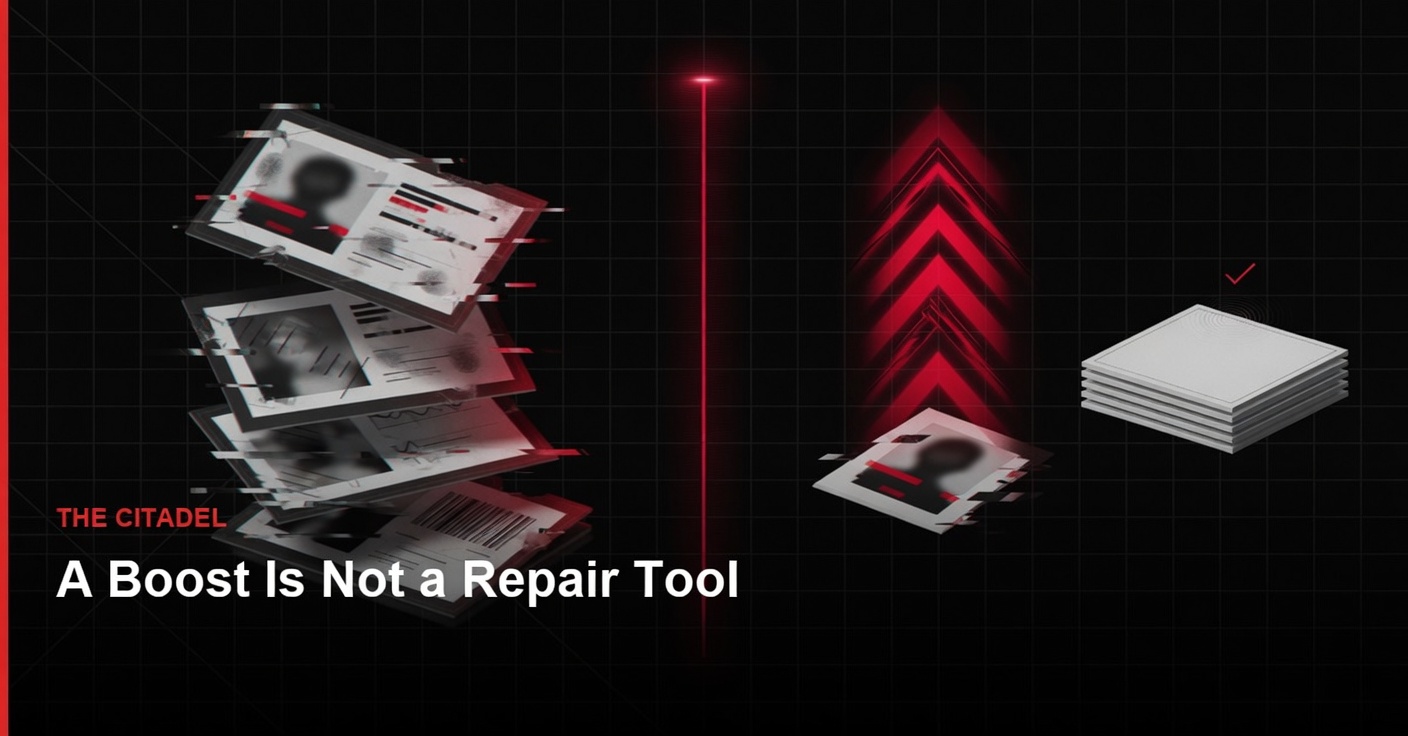
An Amplifier, Not a Repair Tool
A boost is not a repair tool. It is an amplifier. When you pay for a boost on Tinder or Hinge, you are not changing the content of your profile; you are paying the platform to show that content to more people in a shorter window. The transaction is straightforward: the platform takes the existing profile and increases its reach. That is the entire exchange. The problem is that most people treat the boost as if it were a fix for a weak profile, when in fact it only makes the profile's existing weaknesses more visible.
Consider what a viewer actually sees in the few seconds they spend on your profile. They see a lead photo, a few more photos, a prompt answer or two, and a bio. The viewer is not reading carefully. They are pattern-matching, assembling a quick story about who you are from the visible evidence. When that evidence is coherent, the story is easy to accept. When it is contradictory, the story collapses, and the viewer swipes left not because of any single flaw but because the profile does not add up.
Why Amplifying Contradictions Fails
The most damaging flaw is not a bad photo or a weak prompt in isolation. It is a visible contradiction between elements. A lead photo that shows you in a suit and tie, followed by a prompt answer that says you spend every weekend at a metal festival, creates a mismatch the viewer has to resolve. A bio that claims you are an avid climber, with no photo of you anywhere near a wall, leaves the claim unsupported. These contradictions force the viewer to do work, and the moment a viewer has to work to understand your profile, they are already leaning toward swiping left.
This is where the boost becomes actively harmful. When you amplify a profile with a visible contradiction, you are not just showing more people a mediocre profile. You are showing more people a profile that fails a basic coherence test. The negative signal is amplified along with the reach. The boost does not create the problem; it exposes it to a larger audience. The correction order matters: identify the most visible contradiction, fix that signal first, and only then consider amplification. Paying for visibility before the profile is coherent is paying to broadcast a flaw.
The Fix-First Strategy vs. The Boost Trap
The common approach is seductive in its simplicity. You are not getting matches, so you buy a boost. The logic feels sound: more visibility should mean more matches. The trap is that the boost does not address why you are not getting matches in the first place. If the reason is a visible contradiction in your profile, the boost will simply amplify that contradiction to more people. You will get more views, but the views will convert at the same rate, because the underlying signal has not changed.
The comparison here is not between apps or between boost products. It is between two spending strategies. The boost-first strategy spends money on visibility before fixing the profile. The fix-first strategy spends effort on the profile before spending any money on visibility. The boost-first approach is not wrong because boosts are useless; it is wrong because it assumes the profile is already good enough to benefit from amplification. That assumption is often false, and it is expensive to test.
Typical advice from dating coaches and forums tends to reinforce the boost-first trap. The advice is usually to buy a boost, see what happens, and then adjust. This is backwards. It treats the boost as a diagnostic tool, when in fact it is a distribution tool. A boost can tell you that your profile is being seen, but it cannot tell you why the profile is not converting. To learn that, you need to examine the profile itself, not the reach.
How a Forensic Profile Audit Functions
The fix-first approach flips the order. Before spending a dollar on a boost, you audit the visible profile signal. You look for contradictions between the photos, the prompts, and the bio. You identify the single most visible contradiction and fix it. Only then do you consider whether amplification is worth the money. This is not a more cautious strategy; it is a more rational one. It makes the boost spend conditional on a clean profile, which is the only condition under which a boost can work as intended.
An evidence-led audit of your dating profile looks for these visible contradictions in the photos, prompts, and bio. It examines the sequence of photos, checks whether the lead photo supports the claims in the bio, and verifies that the prompt answers do not contradict the visual evidence. The output is a correction order: a ranked list of what to fix first, based on which contradiction is most likely to be seen and most likely to cause a trust drop.
This is a different kind of output from a generic score. A correction order tells you that your lead photo contradicts your first prompt, and that fixing that contradiction matters more than rewriting your bio. That is actionable. It gives you a sequence of operations, not a judgment.
It is important to be clear about what the audit cannot do. No audit can guarantee outcomes, because the outcome depends on factors outside the profile: the local dating pool, the algorithm's mood, timing, and sheer luck. The audit is evidence-led, meaning it works from the visible profile evidence, and it is private, meaning your profile is not shared. But it is not a magic wand.
Concrete Example: Formal Suit vs. Backpacking Prompt
Let's walk through a concrete example, illustrative rather than personalized. Imagine a profile where the lead photo shows a man in a sharp suit at a formal event. The first prompt answer says his ideal weekend is a backpacking trip with no cell service. The bio mentions he is a foodie who loves fine dining. The second photo shows him at a barbecue. The third shows him at a desk.
The visible contradiction is between the lead photo and the first prompt. The lead photo says formal, polished, event-ready. The prompt says rugged, outdoorsy, disconnected. The viewer has to decide which one is the real person, and that decision is a reason to swipe left. The bio claim about fine dining is supported by the lead photo, but it is contradicted by the backpacking prompt. The profile is sending three different signals about who this person is, and none of them are reconciled.
The highest-leverage fix is to resolve the contradiction between the lead photo and the first prompt. This is the most visible conflict, because the lead photo and the first prompt are the two elements a viewer is most likely to see. The fix could be to change the lead photo to one that matches the outdoorsy prompt, or to change the prompt to match the formal lead photo. The choice depends on which signal is more authentic. The point is to make the profile tell one coherent story.
The Pre-Spend Audit Checklist
The order of operations matters. Fix the photo sequence first, because photos are the primary signal. Then fix the prompts, because they are the secondary signal. Then fix the bio, because it is the tertiary signal. This is not a random order; it reflects how a viewer processes the profile. They see the photos first, then the prompts, then the bio. The correction order should mirror the viewing order.
Before you spend a dollar on a boost, run this checklist. Look at your lead photo and your first prompt. Do they tell the same story? Look at your bio claims. Is each one supported by at least one photo? Look at the photo sequence. Does it flow, or does it jump between different versions of you? If you find a contradiction, fix it before you amplify. The boost will be more effective on a profile that is coherent, because it will be amplifying a signal that is worth seeing.
The argument is simple: fix first, then amplify. A boost is a tool for increasing the reach of a signal that is already working. If the signal is broken, the boost only makes the breakage more visible. The correction order is the key insight: identify the most visible contradiction, fix it, and only then consider spending money on amplification. This turns boost spend from a gamble into a conditional investment.
Where to Go Next
The private, evidence-led audit is the diagnostic that reveals the correction order. It looks at the visible profile evidence, finds the contradictions, and tells you what to fix first. It does not give you a generic score or a vague compliment. It gives you a sequence of operations. That is what you need before you decide whether a boost is worth the money.
If you are considering a boost, the question is not whether boosts work. The question is whether your profile is ready for one. The audit answers that question by showing you what is broken and what to fix first. Make your boost spend conditional on a clean profile, and you will stop paying to broadcast flaws.
A free one-photo lead check is not a full audit. It answers first-frame readability only. It is not a 1 to 100 attractiveness score, and it is not a reason to boost.
Inspect the profile audit at the private dating profile audit to see the correction order for your own profile before you spend another dollar on visibility.
Related Essays
Why Boosts Fail on a Contradictory Profile
Boosts amplify profile signals. If photo sequence, bio, and prompts contradict, paid visibility multiplies confusion—not matches.
Dating Profile Photos: What Actually Makes a Bad First Impression
If the first five seconds reject the profile, nothing else can recover it. Learn the photo mistakes that matter before spending more on dating apps.
The Private Profile Audit: Why Fixing Visible Signals First Beats Public Feedback
Visible profile evidence to analyze before you spend on boosts, resets, or copy rewrites.